
Composite Sandwich Panel Analysis
Deflection, stiffness, and failure mode assessment for sandwich panels with composite facesheets and a foam, honeycomb, or balsa core.
A composite sandwich panel is a structural element made of two thin, stiff composite facesheets bonded to a thick, lightweight core, giving high bending stiffness at very low weight. The sandwich panel tool analyses a rectangular panel of this construction under uniform transverse pressure1 and checks each of the failure modes that only exist once a core is involved.
A sandwich panel works on the same principle as an I-beam. Bending stiffness grows with the square of the distance between the load-carrying flanges, so pushing two thin facesheets apart with something light buys an enormous increase in stiffness for very little weight. The facesheets carry the bending load as tension and compression; the core's job is to hold them apart and to transfer shear between them. That division of labour is what makes core properties matter in a way a solid laminate's do not.
When to use this tool
Use the sandwich panel tool when a solid laminate would need to get thick, and therefore heavy, to meet a deflection or buckling requirement: hulls and decks, floor and bulkhead panels, fairings, wind turbine shells, and any wide flat panel loaded in bending. It answers two questions at once: how much the panel deflects under a given pressure, and which failure mode governs the design.
The tool takes the facesheet stiffness from Classical Lamination Theory and combines it with the core properties and panel geometry. When the facesheet laminate carries strength data, it also checks facesheet first ply failure (Maximum Stress criterion); for a full criterion comparison, run the First Ply Failure tool alongside it. For a flat panel without a core, use the plate tool instead.
Inputs
- Facesheet laminate defines the stiffness of both face layers; the same laminate is used for top and bottom. A mirror-bottom option reverses the bottom facesheet's stacking order, keeping the panel symmetric about the core mid-plane even when the facesheet laminate itself is unsymmetric.
- Core material: shear modulus (Gc), compressive modulus (Ec), and optionally shear strength (Fsu) and compressive strength (Fcu). Preset cores (Nomex honeycomb, Rohacell, Divinycell, balsa) are available.
- Panel length (a), width (b), and core thickness (c).
- Applied pressure (q): uniform transverse pressure.
Results
- Bending & shear deflection are reported separately so you can see whether the panel is bending-dominated or shear-dominated.
- Failure mode assessment checks the sandwich failure modes (facesheet stress, core shear, face wrinkling, core crushing, general buckling with core shear correction, shear crimping) and reports a safety factor for each mode with an allowable. The facesheet stress safety factor is a per-ply first ply failure check (Maximum Stress criterion, both load directions, worse facesheet governs); it requires strength properties (S1t, S1c, S2t, S2c, S12) on every facesheet ply and is reported without a safety factor when any are missing.
- Governing mode & minimum SF highlights the critical failure mode with the lowest safety factor.
Stiffness and deflection
Two stiffnesses describe the panel: a flexural stiffness carried by the facesheets acting about the panel mid-plane, and a shear stiffness carried by the core. Deflection under pressure is the sum of a bending part and a shear part, and the split between them is itself a design result: a shear-dominated panel wants a stiffer or thicker core, not heavier facesheets.
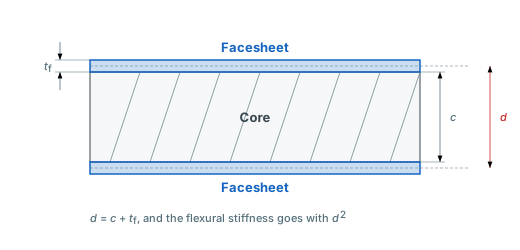
The three dimensions every formula below is written in. Note that d runs between facesheet centroids rather than between the outer faces, so it is not the total panel thickness.
| Symbol | Name | Formula |
|---|---|---|
| Dpanel | Panel flexural stiffness | |
| S | Shear stiffness | |
| wb | Bending deflection | |
| ws | Shear deflection |
- Dpanel - Panel flexural stiffness: Bending stiffness per unit width (N·mm), from facesheet modulus Ef, facesheet thickness tf, and the distance d between facesheet centroids. The d² term is the whole point of a sandwich: doubling the core thickness roughly quadruples the stiffness.
- S - Shear stiffness: The core's resistance to shearing the facesheets past each other (N/mm), from core shear modulus Gc and core thickness c. Sets the shear deflection and caps the buckling load.
- wb - Bending deflection: Mid-panel deflection (mm) from facesheet bending under uniform pressure q: the simply-supported beam formula applied per unit strip across the shorter span b, conservative for a panel supported on all edges.
- ws - Shear deflection: Extra deflection (mm) from the core shearing. Negligible for a stiff core; for a soft core it can exceed the bending part, which is exactly what the separate reporting reveals.
Failure modes
A solid laminate fails one way: its plies break. A sandwich adds failure modes of its own, and the governing one is rarely obvious in advance, which is why the tool reports every mode with its own safety factor rather than a single number.
| Symbol | Failure mode | Formula / allowable |
|---|---|---|
| σf | Facesheet stress | vs first ply failure |
| τc | Core shear | vs Fsu |
| σwr | Face wrinkling | |
| σcc | Core crushing | vs Fcu |
| Ncr | General buckling | |
| Ncrimp | Shear crimping |
- σf - Facesheet stress: Peak in-plane stress in the facesheets from panel bending. The safety factor is a per-ply Maximum Stress first ply failure check; without strength data on every facesheet ply the stress is reported without a safety factor.
- τc - Core shear: Peak transverse shear stress in the core, checked against the core's shear strength. Often the governing mode for foam cores under pressure loads.
- σwr - Face wrinkling: Local instability of a compressed facesheet buckling into the core (MPa). Depends on the core's compressive modulus Ec: a soft core lets the face wrinkle early.
- σcc - Core crushing: Through-thickness compression of the core against its compressive strength. Also the mode that fails under clamps, fasteners, and bagging pressure with no bending load at all.
- Ncr - General buckling: Panel buckling load (N/mm) under in-plane compression, reduced for core shear flexibility. NE = π² Dpanel kmin / b² is the bending-only value, with kmin set by the panel aspect ratio.
- Ncrimp - Shear crimping: The soft-core limit of general buckling: a short-wavelength shear fold of the core at load S. Reported as its own check so you can see when the core, not the facesheets, is capping the panel.
The buckling and crimping rows are two views of the same mechanism. A sandwich buckle shape shears the core, so the soft core lowers the buckling load below the bending-only value NE; in the limit of a very soft core the buckling load levels off at the shear stiffness S itself, and the buckle collapses into the short-wavelength crimp.
The sandwich panel tool. Bending and shear deflection are separated, and every failure mode gets its own safety factor so the governing one is visible at a glance.
Core materials
A core is described by far fewer numbers than a laminate, because it is not asked to do as much. Five properties cover it, and each one lines up with a specific failure mode from the list above:
| Property | Unit | What it governs |
|---|---|---|
| Gc, shear modulus | MPa | Shear deflection, the panel's shear stiffness S, the core shear reduction of the buckling load, and the shear crimping allowable. The core's most important stiffness property |
| Ec, through-thickness compressive modulus | MPa | Face wrinkling resistance, since a soft core lets the facesheet buckle locally into it |
| Fsu, shear strength | MPa | The core shear failure check |
| Fcu, compressive strength | MPa | Core crushing under pressure, and local crushing under fasteners or clamping |
| Density | g/cm³ | Nothing structural on its own, but it is the currency the other four are bought with |
Notice that a core has no directional stiffness in the plane and no orientation to set. It is treated as isotropic here, which is a good description of foam and balsa and a simplification for honeycomb: real honeycomb has different shear moduli in its two ribbon directions, typically differing by roughly a factor of two, and the analysis uses the single value you supply. If that difference matters for your panel, enter the weaker direction.
The three families in common use trade off differently:
- Honeycomb (aluminium, or aramid paper such as Nomex) gives the best stiffness and strength for its weight, which is why it dominates aerospace. The cells are open, so it needs sealing at edges and around fasteners, and it is the least forgiving to process.
- Structural foam (PVC such as Divinycell, PET, PMI such as Rohacell) is closed-cell, easy to machine and shape, and takes a bonded joint anywhere on its surface. Weaker than honeycomb of the same density, and the cheapest to work with. The usual choice in marine and wind.
- Balsa is end-grain timber, so it is stiff and strong through the thickness at low cost. It absorbs resin and water, is variable as a natural material, and is heavier than a foam of comparable stiffness.
Within any one family, properties scale with density, so a core selection is largely a density selection. Note also that a core failure is often not a facesheet-driven event at all: crushing under a clamp, a fastener, or a bagging pressure spike happens with no bending load involved.
The dashboard keeps cores in your material library alongside fibers, matrices, laminae and laminates, each with an optional source field so a datasheet or handbook value stays traceable. Presets for common Nomex, Rohacell, Divinycell and balsa grades are available to start from.
Cores live in the material library alongside fibers, matrices and laminates, with presets for common grades.
Author: Rick Schrijver
References
- Zenkert, D. (1995). An Introduction to Sandwich Construction. EMAS Publishing. ISBN: 978-0947817760. (Sandwich panel theory, wrinkling, and failure modes)
- US Department of Defense. (1968). Structural Sandwich Composites, MIL-HDBK-23A. (Core material properties, honeycomb and foam core design data, face wrinkling and core crushing)
- Barbero, E.J. (2018). Introduction to Composite Materials Design, 3rd ed. CRC Press. Chapter 10. (Sandwich panel design and core selection) doi:10.1201/9781315296494
Frequently Asked Questions
Try it yourself
Analyse a sandwich panel with your own facesheet laminates and core materials. Create a free account to get started.
Create free account