
Free Failure Criteria Calculator
Results
Tsai-Wu governs: SF = 1.29, the ply survives.
SF ≥ 1.0 means the ply survives.
| Criterion | FI [-] | SF [-] | Mode |
|---|---|---|---|
| 0.500 | 2.00 | Matrix tension | |
| 0.551 | 1.35 | Matrix tension | |
| 0.698 | 1.29 | Matrix tension | |
| 0.445 | 1.50 | Matrix tension | |
| 0.687 | 1.46 | Matrix tension (IFF-A) | |
| Also in the dashboard: Max strain, Cuntze, Sun and Edge. | |||
Beyond the Live Calculator
Start from a layup and a load instead of ply stresses. The app finds the stresses in every ply and runs nine criteria on each, with first ply failure and progressive failure.
Create free accountHow the Failure Criteria Calculator Works
Three steps from ply stresses to a safety factor.
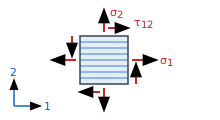
Stresses in the ply axes
Every criterion here works on the stresses in the ply's own axes: σ1 along the fibers, σ2 across them and the in-plane shear τ12. In a laminate you get them by rotating the laminate stresses through the ply angle. Here you type them in directly, along with five strengths from the material datasheet: Xt and Xc along the fibers, Yt and Yc across them, and S12 in shear.
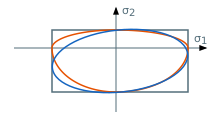
Five ways to combine them
Max stress checks each stress against its own strength and ignores interaction. Tsai-Hill and Tsai-Wu fold all three stresses into one quadratic, so a ply carrying shear fails at a lower σ2 than one without. Tsai-Wu also has linear terms, which let tension and compression strengths differ. Hashin splits the check into fiber and matrix failure, each with its own equation. Puck splits it too, into fiber failure and inter-fiber failure, and checks inter-fiber failure on the fracture plane, with inclination parameters that set how σ2 and τ12 combine there. That is why the five can disagree on the same stresses, and the envelope plot shows where.
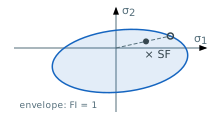
From failure index to safety factor
Each criterion returns a failure index (FI), and FI ≥ 1 means the ply fails. The safety factor (SF) is the factor on all three stresses together that brings FI to exactly 1. For max stress and Puck SF = 1/FI. For Tsai-Hill and Hashin it is 1/√FI, because they are quadratic. For Tsai-Wu it is the positive root of a quadratic, since the linear terms do not scale the same way. The lowest SF of the five governs, and SF ≥ 1.0 means the ply survives.